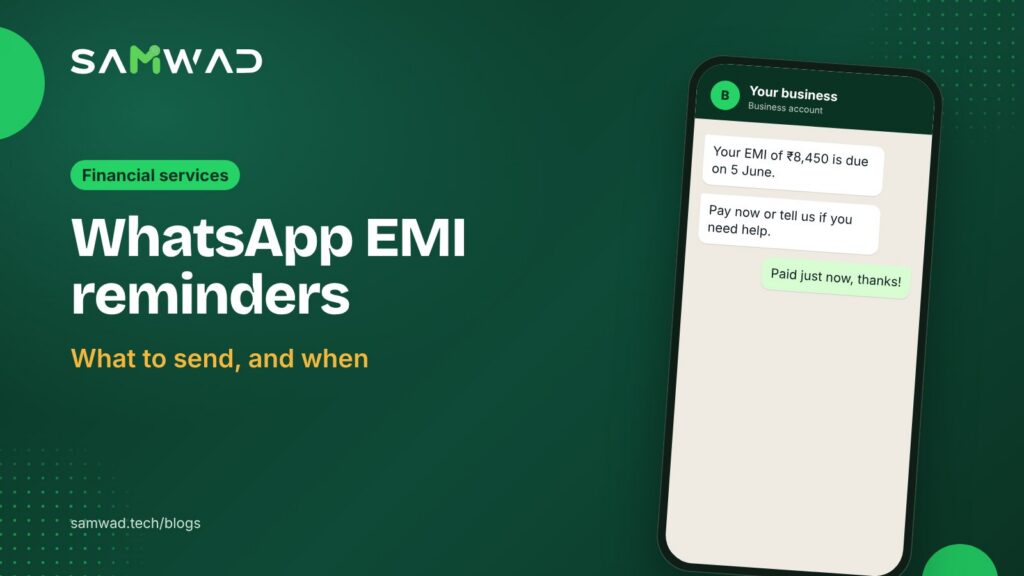
Most missed EMIs aren't refusals to pay. A borrower forgets the date, the salary lands a day late, or the auto-debit fails and nobody notices. A clear reminder a few days before the due date solves a large share of that, and WhatsApp is where most borrowers will actually see it.
This guide covers what a good WhatsApp EMI reminder says, when to send it, how to keep it in Meta's lower-cost utility category, and how to set it up so your collections team only handles the conversations that need a person.
In short
- Send reminders before the due date, not only after it.
- Stick to the facts of the loan so the template stays in Meta's utility category.
- Give borrowers a way to answer: a payment link, an "already paid" button and a way to reach your team.
- Keep messages inside daytime hours. RBI bars recovery calls before 8 am and after 7 pm.
Why WhatsApp works for EMI reminders
An SMS reminder is one-way. A WhatsApp reminder is the start of a conversation. The borrower can tap to pay, reply "paid yesterday", or ask to change the debit date, and your team sees the reply in the same thread.
That two-way thread matters for cost as well. When a borrower replies, a 24-hour customer service window opens, and your replies inside it are free. You only pay for the template that starts the conversation.
What a good EMI reminder says
Keep it short and specific. Every reminder should answer four questions: how much, by when, for which loan, and how to pay.
- Amount and due date, written out in full.
- A loan reference, such as the last four digits of the loan account. Never the full account number.
- How to pay: a payment link, your UPI ID or a note that the auto-debit will run.
- How to get help: a button that brings a person into the chat.
Hi {{name}}, your EMI of ₹{{amount}} for loan ending {{loan_last4}} is due on {{due_date}}.
Your auto-debit will run on the due date. Please keep the amount in your account, or pay now using the link below.
Pay nowAlready paidTalk to us
Leave out offers, top-up loans and anything promotional. Those belong in a separate marketing message to borrowers who have opted in to offers.
A reminder schedule borrowers won't mind
One message on the due date is often too late. A short sequence works better, and each step should be useful on its own.
| When | What to send | Goal |
|---|---|---|
| 5 days before | Amount, due date and how to pay | Give the borrower time to arrange funds |
| 1 day before | Short reminder with the payment link | Catch people who forgot |
| Due date, morning | Note that the auto-debit runs today | Prevent a bounce |
| 1 day after | Polite note that the payment hasn't been received | Fix failed debits early |
| 3 to 5 days after | Offer a callback or a revised date | Move the case to your team |
Send between about 9 am and 6 pm. RBI's 2022 direction to banks and NBFCs says recovery agents must not call borrowers about overdue loans before 8 am or after 7 pm. It's sensible to keep your reminder messages inside the same hours.
Keep the reminder in the utility category
Meta sorts every template into a category, and the category sets the price. A utility template follows up on something the customer already has, such as an account or a payment that's due, and must have no promotional intent. A payment reminder for an existing loan fits that description.
If you add an offer to the same template, Meta can move it to marketing during its regular reviews. The template still sends, but at the marketing rate. At Meta's India rates as of January 2026, a utility message sent outside the 24-hour window costs about ₹0.115 before GST, and a marketing message about ₹0.86. Meta can change its rates, so check the current ones in your WhatsApp Manager.
SAMWAD's AI advisor, SAGE, checks each template against Meta's rules before you submit it, which helps you catch promotional wording early. See WhatsApp message templates for how that works.
Let borrowers answer, and route the replies
A reminder that nobody can reply to wastes the best part of WhatsApp. Plan for the three replies you'll get most:
- "I've already paid." Ask for the transaction reference and pass it to your team to reconcile.
- "Can I pay on the 10th instead?" Capture the new date with a short WhatsApp Flows form, then hand it to a person to approve.
- A general question, such as the outstanding balance or foreclosure charges. Your AI agent can answer the common ones from your policy documents and hand the rest to your team.
In SAMWAD, these replies land in the shared team inbox, where you can assign them to collections or customer service. YARA, the AI agent, handles the routine questions and passes a chat to a person with its full history.
How to set it up in SAMWAD
- Collect WhatsApp opt-in when the loan is booked. Meta requires that the borrower agrees to hear from your business, and it suggests naming the kinds of messages they'll get.
- Create one utility template for each step in your schedule, and let SAGE check them before you submit them to Meta.
- Each week, upload the list of EMIs falling due as a CSV, or connect your loan management system through the WhatsApp API integration.
- Send each step to the right group of borrowers as a WhatsApp campaign.
- Watch delivery, read and reply rates, and move borrowers who don't respond to a call from your team.
Questions
Are EMI reminders utility or marketing messages?
A reminder about a payment that's due on an existing loan generally fits Meta's utility category, as long as it has no promotional content. Add an offer and Meta can recategorise it as marketing.
Do borrowers have to opt in?
Yes. Meta's policy requires that a person agrees to receive messages from your business before you message them. Collect opt-in at onboarding and record it.
What does a reminder cost?
You pay Meta's per-message charge for the template. At January 2026 India rates, that's about ₹0.115 for a utility message before GST. Replies inside the 24-hour window are free. SAMWAD passes Meta's charges through at cost: see WhatsApp Business API pricing.
For a wider view of how lenders and insurers use WhatsApp, from enquiry to renewal, see WhatsApp for financial services or download the lenders and insurers guide.