For the last few years, businesses have largely looked at WhatsApp as a communication channel.
Send a campaign.
Reply to a customer.
Share an order update.
Handle a support query.
Send a payment reminder.
That model is now starting to change.
What I find far more interesting is what happens when WhatsApp stops being just a place where messages are exchanged and starts becoming an interface through which customers can actually get things done.
A customer should not have to understand which department they need, which webpage to open, or which menu option to select.
They should simply be able to say:
“Where is my order?”
or
“Show me black shirts below ₹2,000.”
or
“Can I reschedule my appointment for tomorrow?”
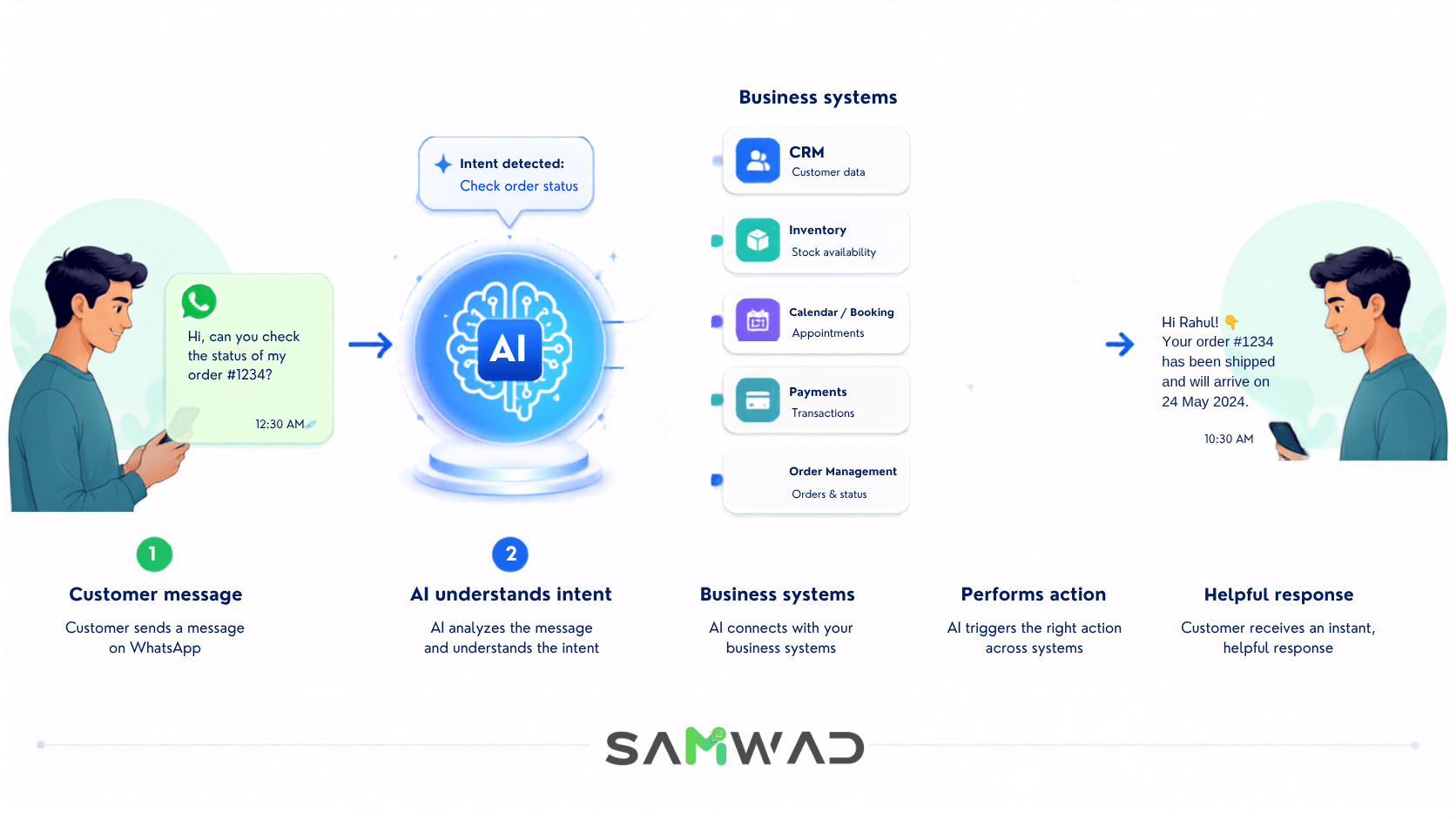
And the system should understand what the customer wants, interact with the relevant business systems, and complete as much of the task as possible.
That, in my view, is where conversational AI becomes genuinely useful.
We Have Already Gone Through the First Phase of WhatsApp Automation
When we started building SAMWAD, the immediate problems businesses wanted solved were fairly clear.
They wanted to manage conversations from one place.
They wanted to send campaigns.
They wanted to automate repetitive replies.
They wanted better visibility into customer communication.
And they wanted to connect WhatsApp with the rest of their operations.
These problems still matter.
But while building SAMWAD and speaking with businesses, I have increasingly felt that traditional automation solves only part of the problem.
Most automation today still depends heavily on predefined rules.
If the customer sends X, do Y.
That works very well when the journey is predictable.
The challenge begins when customers do what customers normally do: they ask questions in their own words.
They change their mind halfway through a conversation.
They combine multiple questions into one message.
They expect the business to remember context.
And they do not care how complicated the systems behind the business are.
This is where AI changes the nature of the conversation.
The Difference Between a Chatbot and an AI Agent
The word chatbot has been used so widely that almost anything which automatically responds to a customer is now called one.
But there is an important distinction.
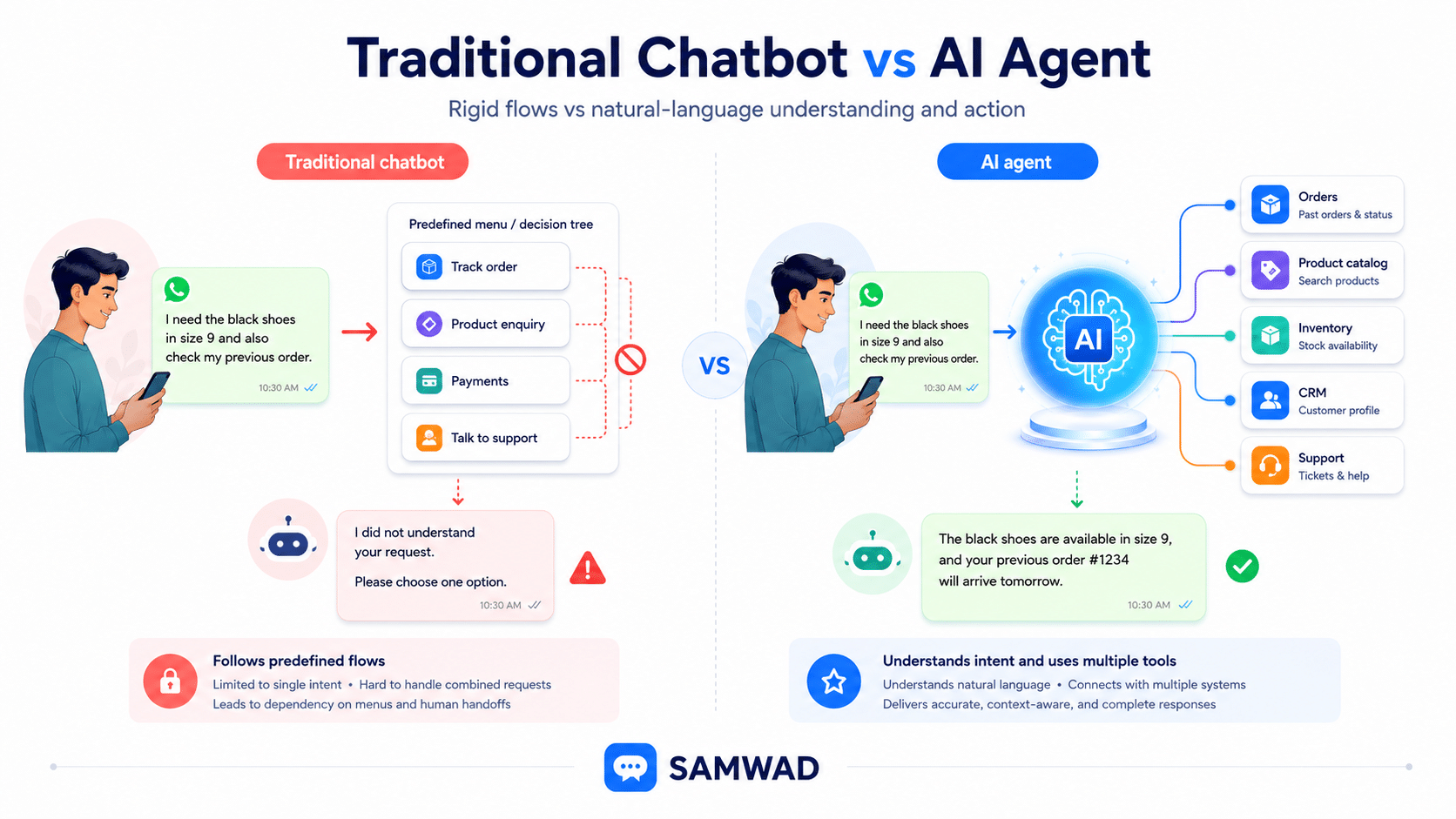
A traditional chatbot primarily follows a defined conversation path.
An AI agent should be able to understand a goal and decide what needs to happen next.
Imagine an e-commerce customer asking:
“I ordered two kurtas last week. One has arrived but the blue one hasn't. Can you check?”
A basic chatbot may struggle unless that exact journey has been designed beforehand.
An AI-powered system can potentially identify:
- who the customer is,
- which order they are referring to,
- which product is pending,
- the current delivery status,
- whether there is an exception,
- and what information needs to be communicated.
The conversation becomes less about navigating a bot and more about simply telling the business what you need.
That is a significant shift.
The Real Opportunity Is Not Better Answers. It Is Action.
This is one area where I think a lot of the discussion around AI customer support becomes too narrow.
If AI only gives a better-written answer, the value is limited.
The real value begins when AI can interact safely with the systems a business already uses.
E-commerce
A customer asks:
“Do you have this in XL?”
The AI should be able to check the product catalogue and inventory.
The customer then says:
“Yes, order the black one.”
The system should be able to guide that customer towards completing the purchase rather than simply replying with a product link and ending the conversation.
Education
A parent asks:
“What is the fee for Class 8 and is transport available in Sector 62?”
Need help turning WhatsApp into a revenue channel?
SAMWAD helps teams automate campaigns, support, and lead conversion with an AI-native WhatsApp stack.
The AI should be able to answer from verified institutional information, capture the enquiry, and move the lead into the appropriate admission workflow.
Service Businesses
A customer says:
“I won't be available on Friday. Can you shift my appointment to Saturday evening?”
Instead of replying with a phone number, the system should eventually be capable of checking availability and helping complete the rescheduling process.
This is what makes the phrase AI agent meaningful.
The AI is not just talking.
It is helping the customer accomplish something.
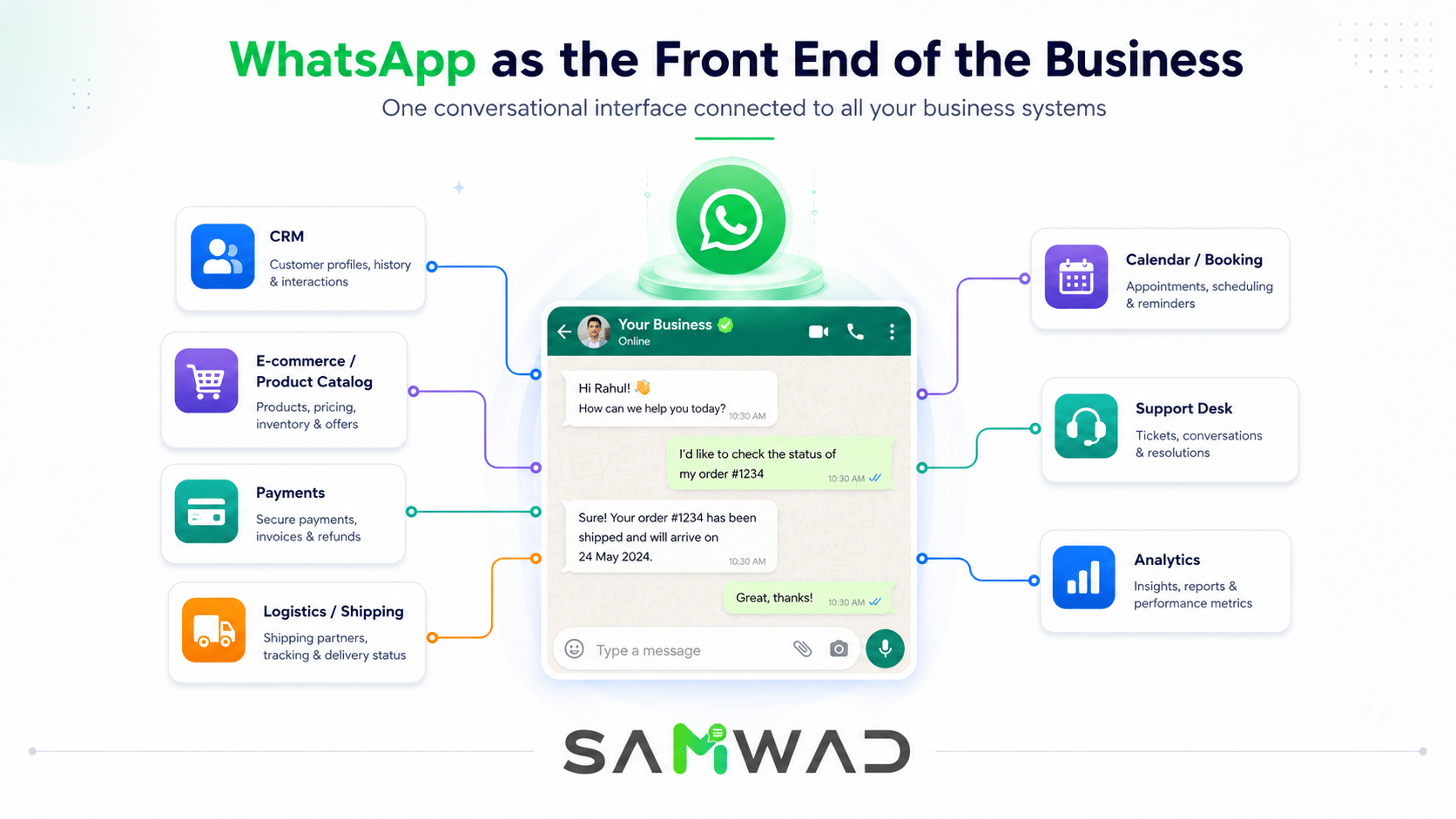
WhatsApp Can Become the Front End of the Business
Most businesses today have several different systems running behind the scenes.
A CRM.
An e-commerce platform.
A billing system.
A support desk.
A booking tool.
A logistics provider.
Maybe even an internal ERP.
Customers should not need to know any of this.
From their perspective, the business is one entity.
This creates an interesting possibility.
What if WhatsApp becomes the simple conversational layer sitting above all these systems?
The customer interacts in natural language.
The AI determines intent.
The relevant business system provides the data or performs the authorised action.
And the result comes back through the same conversation.
In that model, WhatsApp is no longer just another communication channel.
It starts becoming a user interface for the business itself.
But AI Agents Should Not Mean Removing Humans
Whenever AI and customer service are discussed together, the conversation often becomes “AI versus human support”.
I think that is the wrong framing.
There are conversations where automation makes obvious sense.
- “Where is my order?”
- “What are your working hours?”
- “Send me my invoice.”
- “Do you have this item in stock?”
These should not require a person to manually search through another system every single time.
But there are also conversations where judgement, empathy or authority matters.
- A complicated complaint.
- A high-value customer.
- A refund exception.
- A sensitive financial conversation.
- A commercial negotiation.
The better system is one that knows when automation is appropriate and when a human should take over.
The objective should not be to eliminate human conversations.
It should be to eliminate unnecessary repetitive work so that people can spend more time on the conversations where they actually add value.
AI Should Help the Business User Too
There is another side of this that interests us a lot at SAMWAD.
AI conversations do not have to be limited to the customer.
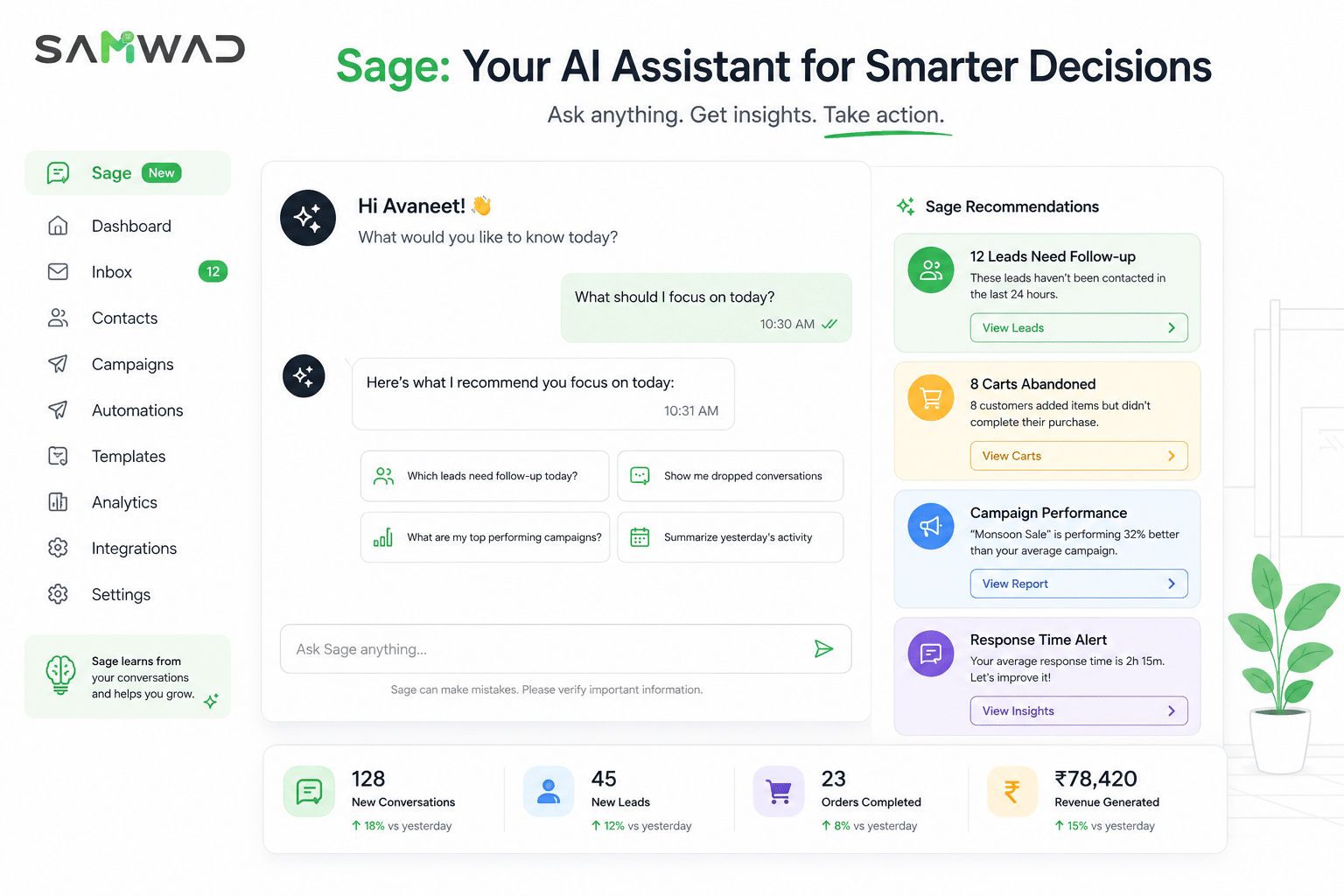
The person running the business should also be able to interact with their own customer data conversationally.
Instead of opening multiple reports and trying to figure out what requires attention, imagine asking:
“Which leads need follow-up today?”
or:
“Which customers asked about pricing but haven't purchased?”
or:
“What were the biggest customer complaints this week?”
or:
“Which campaign generated the most serious enquiries?”
This is part of why we built Sage, our AI assistant inside SAMWAD.
The idea is simple: software should increasingly be able to tell the business owner what deserves attention, rather than expecting the business owner to continuously search through dashboards.
From Dashboards to Conversations
For decades, business software has been built around menus, dashboards, tables, forms and reports.
These interfaces are not going away.
They remain extremely useful when someone needs precision and control.
But AI introduces another layer.
Sometimes the fastest interface is simply a sentence.
Instead of:
a business user may simply ask:
“Show me customers who enquired this week but haven't received a follow-up.”
The AI can translate the request into actions performed across the underlying system.
This is why I believe the idea that AI becomes part of the interface is more important than simply adding a chatbot icon to an existing application.
The interface itself starts adapting to the user's intent.
The Difficult Part Is Not the AI Model
Interestingly, building this well is not just an AI problem.
The model may understand the customer's request perfectly.
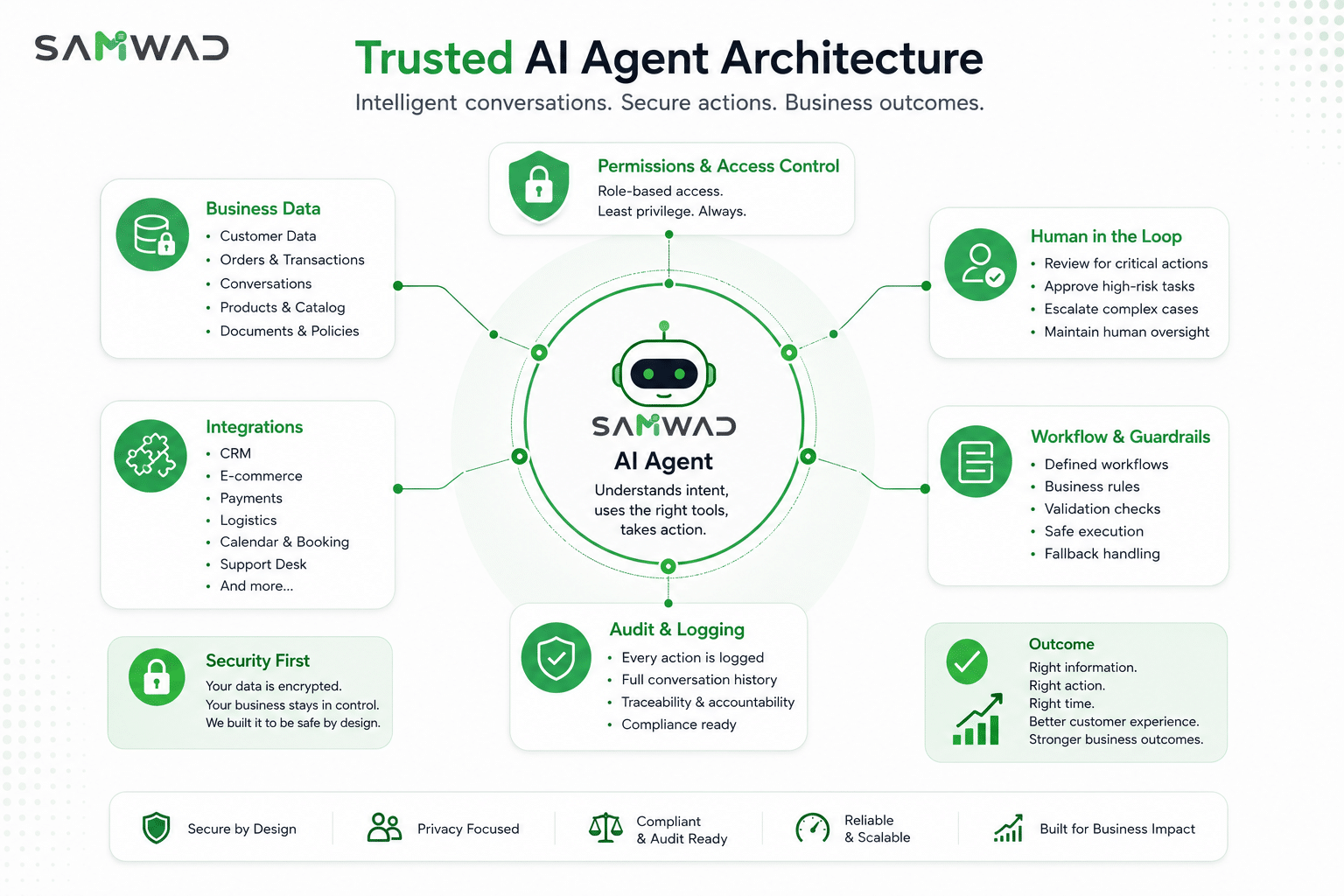
But the system still needs to know:
- which customer is speaking,
- which organisation they belong to,
- what data the AI is allowed to access,
- what actions it is authorised to perform,
- which information is reliable,
- when human approval is required,
- and how every action is logged.
This becomes even more important for businesses operating at scale.
An AI agent that confidently performs the wrong action is far more dangerous than a chatbot that simply says, “I don't understand.”
So the future of business AI will depend as much on permissions, integrations, context, workflows and safeguards as it does on the intelligence of the underlying model.
What We Are Building Towards With SAMWAD
Our original focus with SAMWAD was helping businesses communicate with customers more effectively through WhatsApp.
That remains the foundation.
But the way we see the product is evolving.
Messaging is becoming more intelligent.
Business systems are becoming more connected.
AI can increasingly understand intent instead of depending entirely on predefined flows.
And customers increasingly expect businesses to respond immediately.
When these trends come together, the opportunity is bigger than messaging automation.
We believe conversations can become an operating layer between customers, employees and the systems businesses already use.
That is the direction in which we are building SAMWAD.
Not simply:
Send more WhatsApp messages.
But eventually:
The Businesses That Benefit First May Not Be the Largest Ones
One might assume that this kind of AI automation will first be useful only for large enterprises.
I am not convinced.
In many cases, smaller and mid-sized businesses feel the problem even more.
A business receiving hundreds of enquiries may have only a handful of people handling them.
The founder may still be checking sales conversations personally.
Sales leads may be spread across WhatsApp.
Customer questions repeat constantly.
Follow-ups get missed.
Employees spend time moving information between systems.
These businesses do not necessarily need more software.
They need the software they already have to work together more intelligently.
And conversational AI can become one of the ways to achieve that.
We Are Still Early
There will undoubtedly be mistakes, limitations and lessons as businesses adopt AI agents.
Not every process should be automated.
Not every customer conversation should be handled by AI.
And simply putting an AI model behind a WhatsApp number does not automatically create a good customer experience.
But the direction feels increasingly clear to me.
We moved from websites to mobile applications.
Then many customer interactions moved from applications to messaging platforms.
The next transition may be from navigating interfaces to simply expressing intent.
And when that happens, platforms such as WhatsApp become much more than communication channels.
They become interfaces.
For businesses, that creates an entirely new category of possibilities.
And for us at SAMWAD, it is one of the most interesting problems we are working on.